
Peter Hegemann, Georg Nagle and Karl Deisseroth won The Nobel Prize in physiology or medicine this year. Their work laid the foundation for the field of optogenetics, providing a new way to interrogate how the nervous system works.
What is optogenetics?
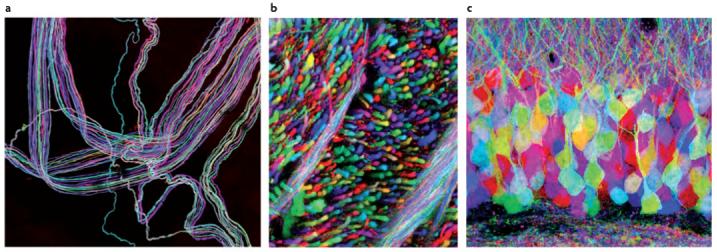
Three brainbows of mouse neurons by Jeff W. Lichtman and Joshua R. Sanes – https://www.ncbi.nlm.nih.gov/pmc/articles/PMC2577038/
The first step to understanding this field involves genetics. The discovery of genetically encoded fluorescent proteins had an enormous impact on biomedical research (The Nobel Prize in Chemistry, 2008). Synthetic, fluorescent dyes were in widespread use at that time, but these dyes labeled all of the cells they encounter. Complex organs like the brain are made up of thousands of different kinds of cells, and understanding how these cells communicate requires cell type specificity. The discovery of fluorescent proteins meant that genetics could be used to express a fluorophore in just the right cells. A beautiful example of this is the brainbow mouse with its amazing images of the cells of the brain (Brainbow)
The discovery of the fluorescent proteins was rapidly followed by the creation of genetically encoded fluorescent biosensors (Biosensor review). Fluorescent proteins were fused to domains from other proteins to create hybrid proteins that would in some way detect an important cellular signal and convert that detection into a change in fluorescence. The biosensors created by Montana Molecular are good examples of these. Small changes in important cellular signaling pathways rapidly produce changes in the fluorescence from the living cell. This means that genetics can be used to target the expression of a biosensor to a particular cell type with remarkable specificity.
Fluorescent biosensors are powerful tools for observe and recording the molecular signaling inside living cells.
Fluorescent biosensors allow researchers to monitor how specific signaling pathways respond to different stimuli, but observing a correlation does not necessarily establish causation. For example, the Andermann lab started with the observation that tail shocks delivered to mice ruined their appetite for a while (Alvarado & colleagues, 2024). Following these tail shocks, the level of cAMP, a key second messenger detected by Montana Molecular’s cADDis sensor, increased in brainstem neurons in the parabrachial nucleus. This made sense, these parabrachial neurons were thought to control appetitive behavior, but is an increase in cAMP actually responsible for the resulting change in behavior? This is where neuroscience used to stop, correlation without causation. The Andermann lab, however, was able to go the next step thanks to optogenetics. They expressed the blue-light sensitive enzyme bPAC in the parabrachial neurons. This bPAC is essentially a photoreceptor that Nagel and Hegemann had isolated from the soil bacterium Beggiatoa (Stierl & colleagues, 2011). Just a brief pulse of blue light is sufficient to excite the bPAC enzyme and fill a cell with cAMP. When they expressed this enzyme in the parabrachial nucleus, and excited it with blue light, the mouse did indeed lose its appetite; the loop was closed, the science was no longer correlative.
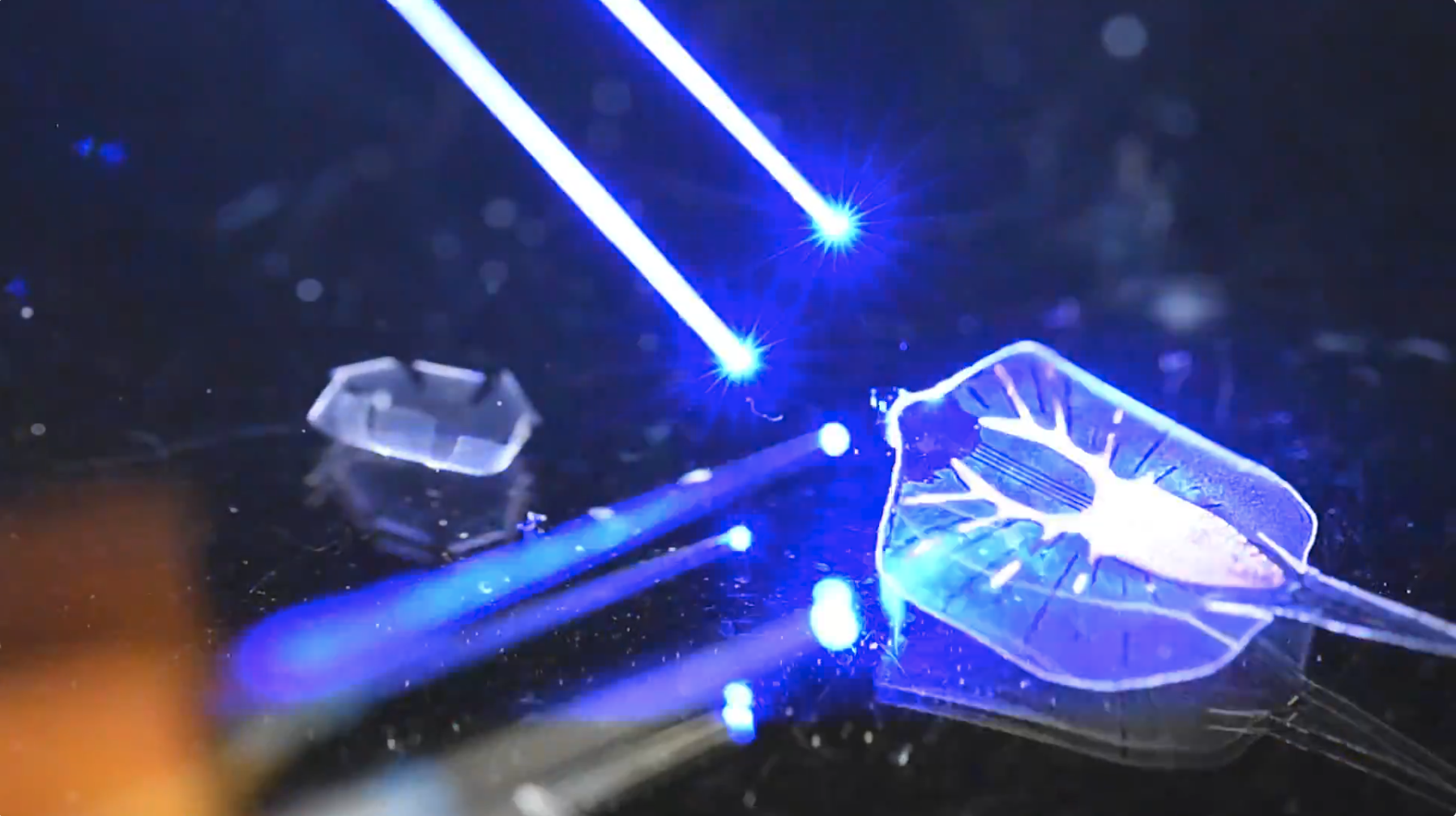
Cyborg ray: Light-guided robotic stingray powered by heart cells https://www.youtube.com/watch?v=E8YwpECaHdw
The powerful bPAC enzyme is just one example of an optogenetic tool. Light is a stimulus, and energy source, for the entire world of biology. As a result, many organisms small and large have developed ways of detecting light and converting it to biochemical signals. The channel Rhodopsins are another good example. These proteins can be activated by light, and this activation causes either an ion channel to open, or an ion pump to be activated. These provide remarkable, ultrafast control of neurons. There are now a host of these proteins which differ in terms of what colored light activates them, and whether they stimulate or silence neurons with remarkable power and precision.The optogenetics toolbox is only beginning to be appreciated. Using it requires creativity and imagination because it empowers us to do entirely new kinds of experiments. Some scientists are trying to use these tools to restore sight in the blind. Others are making incredible machines. For example, Kit Parker’s group made an artificial manta ray, using human heart cells, that they can drive around a dish with a laser pen thanks to optogenetics.
Sidney Brenner once quipped: “Progress in science depends on new techniques, new discoveries and new ideas, probably in that order.” That is certainly true of the field of optogenetics, where we are only beginning to harness the power of these new tools, and new discoveries are just around the corner.